Stocks: Starting a business with friends
Often times, people start companies together with friends or family. How do you “split” things up in a way that’s fair to everyone involved? What’s fair and unfair can get hairy, and different countries and cultures have different takes on this.
In the U.S. and other Western countries, the concept of “shareholders” and “investors” is very well established, and what’s “fair and unfair” as it relates to the question above is also generally understood.
So say that you and two of your friends decide to start a lemonade stand together. It costs $10,000 to start it, and you figure it can generate $4,000 per year in profit.
You offer to put in $5,000 and your other two friends put in $2,500 each, for the total of $10,000.
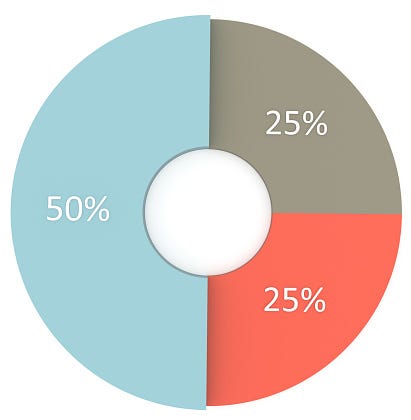
You and your friends agree that you will own 50% of the company, and each friend will own 25%, for a total of 100%. This is because you’re putting in $5,000 of the $10,000 required, and each of your two friends are only putting in $2,500 of the $10,000 required.
The three of you form a company called “Amigos Lemonade”. The company is formed with 1,000 shares of “common stock”. You get 500 of those shares, and each of your two friends get 250 each, which against reflects how much money you’re each putting in. So, you each purchased each share of common stock for $10.00 per share. This means that you put in $5,000 and got back 500 shares.
Each year, the company generates $4,000 per year in profit and distributes it as dividends to its shareholders. A dividend is a payment a company makes to the holder of each share of stock.
The $4,000 gets split up amongst 1,000 shares, so that each share receives a $4.00 dividend. Someone who owns a single share would receive $4.00. Since you have 500 shares, you receive $2,000. Since your friends have 250 shares each, they each receive $1,000.
$4.00 x 500 = $2,000
$4.00 x 250 = $1,000
📚 You’re learning about stocks, shares and dividends.
Great news! Susie wants to buy 100 shares from you!
Susie from down the street heard about Amigos Lemonade and she wants to be part of it. She’s offering to buy 100 shares from you. What’s a fair price?
Susie will do the same analysis as the one in the “What’s a business worth?” section to determine the value of Amigos Lemonade.
Susie looks at the Orange Juice Stand, the Pineapple Juice Stand and U.S. treasury bonds, and calculates the yield that each one of those would give her. Susie decides that she wants an 8% yield from Amigos Lemonade, otherwise she’d rather buy shares in something else.
Based on this, she decides that the business is worth $50,000, or $50.00 per share. She determines this by noting that if someone were to buy Amigos Lemonade for $50,000, they would get $4,000 per year, or a 8% yield. Since there are 1,000 shares, the price per share is $50.00.
So, Susie can buy one share of Amigos Lemonade for $50.00, and in exchange, she will receive $4.00 in dividends per year, which represents a 8% “dividend yield.”
$4.00 divided by $50.00 = 8%
📚 You’re learning about “dividend yield”.
But, what if Amigos Lemonade was making more profit each year? What if next year it makes $5,000 and then $6,000 the next? This will be covered in future sections.
Once you understand how to answer these questions, we can start doing real-life examples on real company stocks.
For now, we need to figure out how to handle grandma’s interest in joining the fun.
Bonds: Starting a business with grandma
Grandma shows up and congratulates you for starting Amigos Lemonade! She mentions she has $20,000 to invest, and she’d like to invest in Amigos Lemonade. But, she’s very afraid of risk, and she doesn’t want to lose that $20,000.
She can always just buy U.S. treasury bonds with that $20,000, and with a 4% rate, she can get $800 per year. But, she likes you and she wants to be involved.
How do you involve her?
One way would be to treat her $20,000 as a loan to Amigos Lemonade that needs to be paid back before anything else.
For example, she can give $20,000 to Amigos Lemonade, and the company can promise to give her some “X dollars” per year, and the $20,000 back in 5-years. You can promise grandma that her “X dollars” per year will be paid before any dividends are paid to common stockholders.
📚 You’re learning about bonds and “capital structure”, and the concept that some types of securities, like loans, get paid back before others.
How do you decide what that “X dollars” is? Grandma, being a savvy investor herself, does a comparable analysis of opportunities with similar risk as Amigos Lemonade. She finds that she can:
- Loan $20,000 to Orange Juice Friends Co. and get $1,200 per year and the $20,000 back in 5-years, or a 6% return per year
- Loan $20,000 to Pineapple Guys Co. and get $1,400 per year and the $20,000 back in 5-years, or a 7% return per year
Given this information, you offer her $1,400 per year and the $20,000 back in 5-years, for a 7% return per year.
What happens now when the company makes profit?
At the end of the year, the company makes $4,000 in profit. The first $1,400 goes to grandma, as promised. This leaves $4,000 minus $1,400 = $3,600 left for the shareholders. There are 1,000 shares, so each shareholder now receives $3.60 in dividends (instead of the $4.00 before the loan).
What happens now when you sell the company?
Now, if you sell Amigos Lemonade for $50,000, the first $20,000 goes to repay grandma, as promised to her. That leaves $30,000 to shareholders, or $30.00 per share.

 Internal Return